
What a Legitimate HVAC Second Opinion Looks Like

A major HVAC repair or replacement recommendation can be quite the process, especially when you’re scoping out a big project and the estimate is more than you expected. That’s why a second opinion can be a practical way to make a better decision and compare.
A legitimate HVAC second opinion should give you clear answers, not more pressure. It should include a real inspection, a written explanation of the issue, options when options exist, and enough detail for you to compare the recommendation with confidence.
ENERGY STAR recommends asking contractors for written, itemized estimates. Those details matter when you are deciding whether to approve expensive HVAC work. Our comprehensive guide gives you everything you need to know before you make a final decision.
When Should You Get a Second Opinion on HVAC Work?
It never hurts to get a second opinion. But getting a second opinion is especially important when your original quote is expensive, urgent, confusing, or based on a diagnosis you don’t fully understand.
We recommend you get a second opinion when:
A technician is telling you your HVAC system needs replacement when you feel the problem is minor.
A larger quote is missing permit information and costs.
The company isn’t clear about the exact cost for services vs. parts.
Two issues are being linked together without clear proof, such as a small repair turning into a full replacement recommendation.
You were told to decide immediately, especially if your system is still running safely.
The estimate is vague, missing model or part details, or does not separate repair and replacement options.
How to Get a Second Opinion on an HVAC Diagnosis
A second inspection can give you more confidence in the original recommendation and help you compare your options clearly. Here’s how to get one:
Ask for the original diagnosis in writing or email. Make sure it explains what was inspected, what was found, and why the repair or replacement was recommended.
Schedule an independent inspection. Share the symptoms you noticed, but let the second technician evaluate the system without relying on the first estimate.
Ask clear questions. Find out what failed, whether repair is still an option, and why replacement may or may not make sense.
Compare both recommendations. Review the diagnosis, scope of work, warranty or workmanship details, and how clearly each company explains your options.
What a Legitimate HVAC Second Opinion Should Include
A real second opinion is more than a quick glance at the first estimate, or comparing the bid or cost. The technician should inspect the equipment, ask about recent symptoms, test system performance, and explain what they find in clear language.
For AC concerns, that may include checking airflow, electrical components, refrigerant-related symptoms, the thermostat, the outdoor unit, and visible wear.
For heating concerns, it may include checking safe operation, ignition or heat-delivery problems, airflow, and system age.
The goal is not to automatically disagree with the first company; it’s to help you understand whether the original recommendation is complete, reasonable, and supported by what is happening in your home.
HVAC Second Opinion Checklist
What to Ask For | Why It Matters |
|---|---|
A fresh inspection | The second technician should verify the issue rather than only react to the first estimate. |
Plain-language diagnosis | You should understand what failed, what is worn, and what still appears to be working. |
Written recommendation | A written summary makes it easier to compare options later. |
Repair vs. replacement explanation | If a replacement is recommended, you should know why a repair isn’t sufficient to solve the issue. |
Photos or readings when useful | Photos, measurements, or test results can make the diagnosis easier to trust. |
Clean work expectations | You should know how the company protects your home and leaves the area after service. |
Red Flags That an Estimate May Be Incomplete or Oversold
Pressure is not the same thing as urgency. Some HVAC problems need quick attention, especially when comfort or safe operation is affected. Still, a trustworthy recommendation should leave room for questions and consideration before you sign.
Here are some red flags to watch out for:
The technician says replacement is the only option but doesn’t explain the failed part or the system’s condition.
The estimate uses broad terms such as "system issue" or "major failure" without specific details.
You are discouraged from getting a second opinion.
You are told a discount offer expires the same day if you don’t sign.
The first inspection was very short, but the recommendation is very large.
What Documentation Should an HVAC Technician Provide?
Before you approve major work, ask for a written estimate that identifies the equipment or component involved, the recommended work, any available options, and what is included in the price. If the recommendation involves system replacement, ask how the technician evaluated the age, condition, capacity, and performance of the current system.
Documentation does not need to feel complicated. It should simply give you enough information to understand the decision and avoid relying on memory after the appointment.
Thorough Estimate vs. Vague Estimate
Thorough Estimate | Vague Estimate |
|---|---|
Explains what was inspected and what was found | Only says the system is bad or failing |
Identifies repair and replacement options when both are realistic | Pushes one option without context |
Includes written details you can review later | Relies mostly on verbal pressure |
Notes warranty, workmanship, or guarantee details | Does not explain what happens if the issue returns |
The technician gives you room to ask questions | Feels rushed and the technician makes you feel embarrassed for asking questions |
How to Compare Two HVAC Estimates Fairly
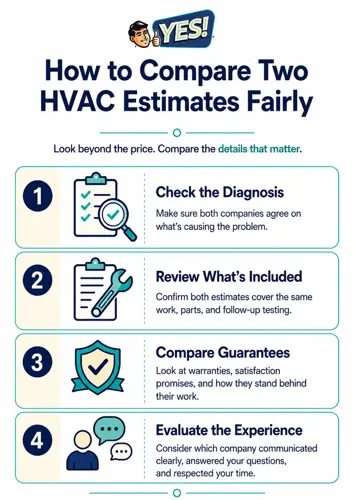
Two estimates may not include the same scope, so do not compare only the final number. Look at the diagnosis, the parts or equipment included, labor, warranties, cleanup, scheduling, the legitimacy of the company, and whether they explain how the recommendation fits.
Compare the diagnosis first. Are both companies identifying the same root issue?
Compare the scope. Are both estimates covering the same repair, equipment, and follow-up testing?
Compare protections. What workmanship warranty, satisfaction guarantee, or service promise is included?
Compare communication. Which company made you feel informed instead of pushed?
Questions to Ask Before Approving a Major Repair or Replacement
What exactly failed, and how did you confirm it?
Is repair still an option, and what are the risks of choosing it?
What makes replacement the better choice?
What is included in the written estimate?
Will your team protect my home and clean up after?
When It Makes Sense to Move Forward With the Original Recommendation
A second opinion sometimes confirms the first recommendation was reasonable. It may make sense to move forward with the original company when both technicians identify the same issue, the original estimate is detailed, the company answers your questions clearly, and the timing works for your household.
The right decision is not always the lowest estimate. It is the option that solves the problem, a contractor who respects your home, and gives you confidence that the work is being handled carefully.
How YES! Can Help With Your HVAC Assessment
YES! helps homeowners in Nevada and Utah make clearer HVAC decisions by offering HVAC second opinions and practical guidance. You can also learn more about HVAC services we offer and find a YES! Location service area near you.
When a technician comes into your home, you deserve clear explanations, respectful service, and a clean work area when the job is complete. YES! keeps the process straightforward so you can decide what comes next without feeling cornered.
Ready for a Second Opinion?
If you are unsure about a major HVAC recommendation, call YES! today or schedule an appointment for a second opinion.
